
By Fortune Mbonu
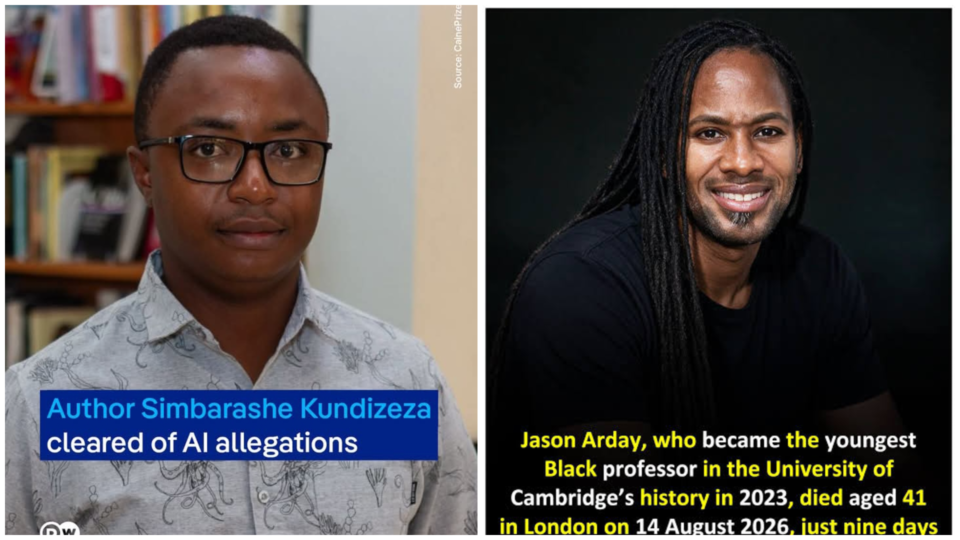
Sometimes, the greatest challenge to an achievement comes after it has been recognised. For two Black African men who attracted international attention for their accomplishments, public scrutiny has become an unexpected part of their stories.
When Zimbabwean writer Simbarashe Steyn Kundizeza received the 2026 Caine Prize for African Writing, it was supposed to be a defining moment in his literary career.
His short story, The Blue Fighter, had earned him one of Africa’s most prestigious literary honours, placing his name among a distinguished generation of African writers.
But the celebration was short-lived.
Just days after the award was announced on October 6, 2026, questions emerged about the originality of his work following an article published by The Atlantic.
The publication reported that an artificial intelligence detection tool, Pangram, had flagged almost the entire story as AI-generated. The report immediately raised questions about whether Kundizeza had genuinely written the award-winning piece himself.
For the Zimbabwean author, however, the allegations were unfounded.
He firmly denied using generative AI, insisting that The Blue Fighter was entirely his work. He explained that the story drew inspiration from personal experiences, including his family’s struggles during Zimbabwe’s economic turmoil.
Rather than accepting the AI detection report as conclusive evidence, the Caine Prize launched an investigation into the matter.
The review included interviews with Kundizeza, members of the judging panel and the publication that originally carried the story. Independent experts also examined metadata from drafts of the manuscript.
On November 11, the organisation announced its decision: Kundizeza had been cleared of the allegations, and his award would stand.
The prize’s chair, Ellah Wakatama, said the evidence supported the conclusion that The Blue Fighter was human-written.
Speaking after the decision, Kundizeza expressed relief, saying he was happy to put the controversy behind him and continue his writing journey.
The organisation also announced new safeguards, including AI-use declarations for publishers and shortlisted writers, as well as a formal policy to guide future submissions.
But beyond the individual controversy, Kundizeza’s experience has reopened an important conversation about technology, credibility and the treatment of African writers in the international literary community.
When recognition comes with scrutiny
Kundizeza’s experience brings to mind another African figure whose remarkable achievements attracted international attention before his story became the subject of intense public scrutiny: British-Ghanaian academic Jason Arday.
Arday’s rise through the academic world was widely celebrated as an extraordinary story of determination and perseverance.
Diagnosed with autism as a child, he reportedly did not develop spoken language until he was 11 and only learnt to read and write at 18.
Despite the challenges associated with his early development, he pursued higher education, eventually earning a PhD and establishing himself as a scholar specialising in race, inequality and education.
In March 2023, at the age of 37, he joined the University of Cambridge as Professor of Sociology of Education, becoming the youngest Black person appointed to a professorship at the institution.
His appointment attracted international attention, particularly because of the remarkable journey that preceded it.
For many people, Arday represented the possibility of overcoming circumstances that might otherwise have limited a person’s opportunities.
His story also became an important symbol of conversations around disability, educational inclusion and racial representation in prestigious academic institutions.
However, like Kundizeza, his public profile eventually became associated with questions about the credibility of his achievements and personal accounts.
In August 2026, Arday resigned from Cambridge following mounting scrutiny of his academic work and aspects of his personal and professional history.
Among the issues raised were allegations of plagiarism in his doctoral thesis, questions about some of his published research, and discrepancies surrounding certain academic appointments and qualifications.
Arday rejected allegations of plagiarism and maintained that investigations had found no academic misconduct. Liverpool John Moores University, which awarded his doctorate, had previously investigated plagiarism allegations and did not uphold them, although it reportedly attributed the similarities identified to honest and reasonable error.
Questions were also raised about aspects of his childhood narrative, including claims that he had been non-verbal until the age of 11. Former schoolmates offered conflicting accounts, with some supporting his account and others challenging it.
His resignation marked a dramatic turn in a career that had once been celebrated as one of British academia’s most inspiring success stories.
Two stories, different circumstances
Although Kundizeza and Arday’s experiences are not identical, there are interesting parallels in how their achievements became subjects of public examination.
Both men achieved recognition in fields where credibility is fundamental.
For Kundizeza, the question was whether the words in his award-winning story were genuinely his. For Arday, scrutiny extended to the originality of his academic research, aspects of his professional record and details of his personal history.
However, there is a significant difference in how their respective controversies have developed.
In Kundizeza’s case, the Caine Prize conducted a review and formally cleared him of the AI allegations. His award remains intact.
Arday’s situation is considerably more complicated. His resignation followed a series of questions and allegations, but those questions should not automatically be treated as established findings of misconduct. Some claims were disputed, and previous institutional investigations did not uphold the plagiarism allegations against his PhD.
Their stories therefore should not be reduced to a simple comparison between an innocent writer and a disgraced academic.
Rather, they demonstrate how quickly public narratives surrounding celebrated individuals can change when questions emerge about the foundations of their achievements.
The danger of allowing technology to become the final judge
Kundizeza’s experience also highlights a growing challenge in the age of generative artificial intelligence.
AI detection tools are increasingly being used to assess whether written material was produced by humans or machines. However, their results should not be treated as definitive proof of authorship.
Writing styles differ, authors evolve, and writers can draw from personal experiences, literary influences and years of practice to produce work that may appear unfamiliar to some readers.
An algorithm flagging a piece of writing should therefore be the beginning of an investigation, not the conclusion.
The Caine Prize’s decision to examine manuscript drafts, metadata and testimony rather than relying solely on an automated detection result provides an important example of why human-led assessment remains necessary.
It also raises a broader question about how African writers are evaluated in international literary spaces, particularly when their work attracts unexpected attention.
Beyond the headlines
There is another important lesson in the experiences of both men.
Recognition can open doors, but it can also place individuals under a level of scrutiny they may never have anticipated.
Kundizeza’s award-winning story was supposed to introduce more readers to his literary voice. Instead, he found himself having to defend the authenticity of his writing.
Arday’s appointment at Cambridge was celebrated as a milestone in representation and educational inclusion. Yet, years later, his professional record and personal narrative became subjects of intense public debate.
Their experiences remind us that remarkable achievements deserve recognition, but they must also withstand fair and evidence-based scrutiny.
For Kundizeza, the latest decision offers an opportunity to return to what matters most: writing.
For Arday, the questions surrounding his career illustrate how difficult it can be to separate a person’s achievements, public image and the claims made about their life.
Ultimately, the two stories offer a timely reflection on the importance of evidence, institutional accountability and the responsibility of the public to distinguish between allegations and established facts.
In an age where a single report, algorithmic assessment or disputed account can reshape someone’s reputation, the importance of getting the facts right has never been greater.
